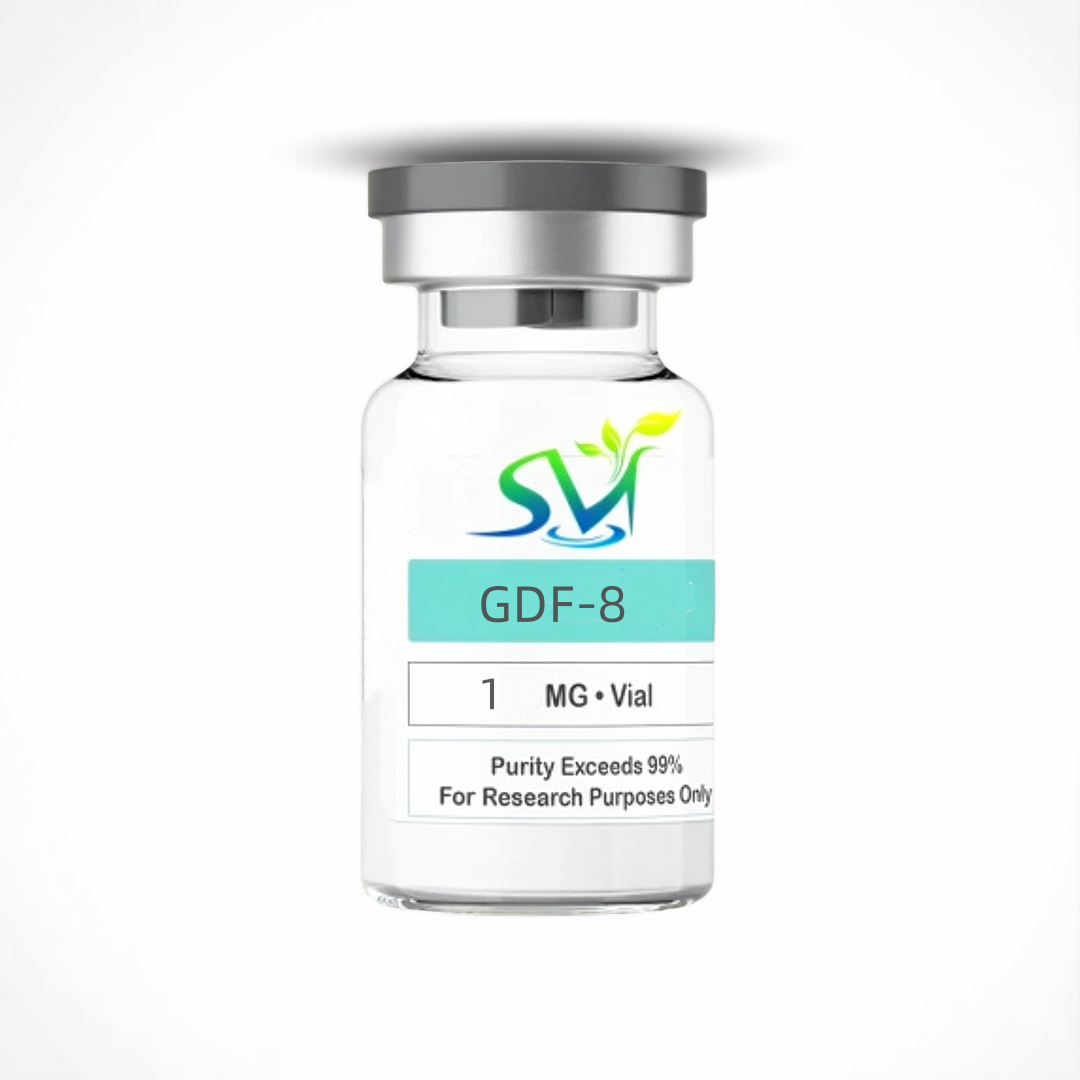
What is GDF-8 (Myostatin)?
GDF-8 (Growth Differentiation Factor 8) is the formal scientific name for the protein commonly known as Myostatin.
-
Its Fundamental Role: It is a myokine, a protein produced and released by muscle cells that acts on muscle tissue itself.
-
Its Primary Function: It acts as a potent negative regulator of skeletal muscle growth. Think of it as your body’s built-in “brake” on muscle size.
Its discovery explained a natural phenomenon: why most animals and humans don’t have unlimited muscle growth.
Mechanism of Action: The “Muscle Limiter”
Myostatin/GDF-8 functions through a specific signaling pathway:
-
Production and Secretion: Muscle cells produce the Myostatin protein and release it into their surroundings.
-
Binding to Receptors: Myostatin binds to specific receptors on the surface of muscle cells, known as Activin type IIB receptors (ActRIIB).
-
Inhibition of Muscle Growth: This binding triggers a cascade of signals inside the muscle cell that ultimately:
-
Inhibits muscle cell differentiation (myogenesis): It slows down the process of creating new muscle fibers from satellite cells (muscle stem cells).
-
Inhibits muscle protein synthesis: It reduces the machinery that builds new muscle proteins.
-
Promotes muscle protein breakdown (atrophy): In some contexts, it can activate pathways that break down muscle tissue.
-
In short, Myostatin tells your muscles, “That’s enough, stop growing now.”
The “Mighty Mouse” and Natural Mutations
The critical importance of Myostatin was dramatically proven in 1997 when researchers genetically engineered “Mighty Mice” that lacked a functional GDF-8 gene.
-
Result: These mice had two to three times more muscle mass than normal mice, demonstrating a “double-muscled” phenotype.
This phenomenon isn’t just lab-made. It occurs naturally in certain breeds:
-
Belgian Blue and Piedmontese Cattle: These breeds have natural mutations in the Myostatin gene, leading to their characteristically massive, heavily muscled appearance.
-
Whippet Dogs: A specific Myostatin mutation is responsible for the “bully” whippet variant, which is extremely muscular and powerful.
-
A Human Case: A German boy was identified with a similar mutation, making him unusually strong and muscular from infancy.
Potential Medical Applications
The dramatic effects of Myostatin inhibition have made it a major target for medical research, aiming to help patients with muscle-wasting diseases:
-
Muscular Dystrophies (e.g., Duchenne Muscular Dystrophy): To help patients maintain muscle mass and function.
-
Sarcopenia: Age-related muscle loss in the elderly.
-
Cachexia: Severe muscle and weight loss often associated with cancer, HIV, and other chronic diseases.
However, developing safe and effective Myostatin inhibitors has proven challenging. Several drug candidates (like Stamulumab and Domagrozumab) have failed in clinical trials due to lack of efficacy or safety concerns.
Use in Performance Enhancement and Bodybuilding
The potential to create massive muscle growth without traditional exercise is highly attractive in the bodybuilding and athletic world.
-
Myostatin Inhibitor Supplements: Many over-the-counter “myostatin inhibitor” supplements exist, but they are largely considered ineffective. They typically contain ingredients like epicatechin or certain plant extracts, but there is no strong evidence they significantly lower functional Myostatin levels in humans.
-
Gene Doping and Research Chemicals: The real, potent Myostatin inhibitors are unapproved and highly experimental. This includes:
-
Follistatin Gene Therapy: Introducing a gene that produces Follistatin, a natural protein that binds to and neutralizes Myostatin.
-
ACE-031 (Sotatercept): A soluble receptor (a “decoy”) that binds to Myostatin before it can reach its actual receptor. As discussed in a previous question, this drug failed clinical trials due to safety issues (bleeding).
-
Monoclonal Antibodies: Antibodies designed to bind and neutralize Myostatin in the bloodstream.
-
All of these potent methods are unapproved, illegal for performance enhancement, and carry severe health risks.
Side Effects and Major Risks
Artificially inhibiting such a fundamental biological “brake” is not without serious consequences:
-
Tendon and Ligament Weakness: Muscles may grow much faster and stronger than the connective tissues (tendons, ligaments) that attach them to bones and stabilize joints. This creates a severe imbalance, dramatically increasing the risk of ruptures and debilitating injuries.
-
Cardiac Complications: The heart is a muscle. While it has some differences from skeletal muscle, inhibiting Myostatin can lead to pathological thickening of the heart muscle (cardiac hypertrophy), which can impair function and lead to heart failure.
-
Unknown Long-Term Effects: The long-term impact of disabling a key regulatory pathway is unknown. It could potentially have effects on metabolism, organ function, and cancer risk.
Key Takeaways
-
GDF-8 is Myostatin, your body’s primary “brake” on muscle growth.
-
Naturally occurring or engineered Myostatin deficiency leads to a massive, “double-muscled” appearance.
-
It is a major target for medical research into muscle-wasting diseases, but successful drugs have been elusive.
-
The pursuit of Myostatin inhibition for bodybuilding and athletics is extremely high-risk. The potent methods are unregulated, illegal, and pose severe threats to tendon and heart health.
-
Over-the-counter “myostatin inhibitor” supplements are largely considered ineffective for producing significant muscle growth.